Nadia Revisited by Selfe Lorna
Author:Selfe, Lorna.
Language: eng
Format: epub
Publisher: Taylor & Francis (CAM)
Nadia did not develop language properly. As described in Chapter 1, the few words she had acquired around 12 months disappeared. At the age of 6 she had extremely limited vocabulary of about 10 words. Testing showed that Nadia had profound difficulties not only with verbal expression but also with comprehension. She appeared to lack many of the prerequisites of language development. She could not imitate. She could repeat monosyllables but not two syllables of different sounds and she was never seen to engage in symbolic play. She was clumsy and poorly coordinated. She could not hop, nor walk up stairs one tread at a time. She did show average-for-her-age ability with some visual matching tasks and jigsaw puzzles. She could match quite difficult items that had the same perceptual quality although she failed to match items in the same conceptual class. She could match a picture of an object to a picture of its silhouette but not pictures of chairs as a class (an armchair, kitchen chair, and a deckchair).
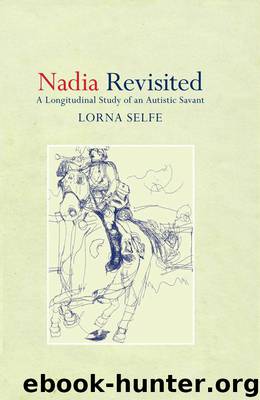
It could be argued that the fact that Nadia was more concerned or better able to record single fixed views of static spatial configurations was due to the fact that her symbolic and verbal abilities were severely retarded. In the absence of the usual domination of conceptual understanding of the world around her, Nadia was better able to attend to and record her purely visual experience (Selfe, 1983).
O’Connor and Hermelin (1978) had shown that autistic children have difficulty in transposing information received in one mode (visual, tactile, or auditory) to another internal cognitive system. They appear to be inflexible in transposing between modalities in a range of tasks where auditory or spatial stimuli were presented but responses had to be given in an alternative mode. For such children, the visual image did not invoke the spoken word, and the written or spoken word did not appear to invoke matching visual images as compared with matched controls (Hermelin & O’Connor, 1970). It can be conjectured that Nadia, as an autistic child, may have had reasonably well-developed imagery and spatial abilities but that her verbal and discursive thought processes were defective. All that we know of her behaviour and intellectual development supports this speculation. Since, presumably normal drawing development results from the normal integration of the various modes of thinking, and verbal and discursive processes are believed to influence the nature of early drawing, it was reasoned that autism and its attributed cognitive deficits accounted for the special spatial, photographic characteristics of Nadia’s drawings. These drawings were seen as a symptom of her autism and of an underlying pathological condition taken in conjunction with her other severe deficits in other areas of functioning. This is not, of course, a necessary symptom of autism; it is in fact a very rare occurrence (Selfe, 1983).
In my second book (Selfe, 1983) I reported on several children with special drawing ability all of whom had learning difficulties and were autistic. I was influenced by Gibson’s view
Download
This site does not store any files on its server. We only index and link to content provided by other sites. Please contact the content providers to delete copyright contents if any and email us, we'll remove relevant links or contents immediately.
Rewire Your Anxious Brain by Catherine M. Pittman(18711)
Talking to Strangers by Malcolm Gladwell(13440)
The Art of Thinking Clearly by Rolf Dobelli(10598)
Mindhunter: Inside the FBI's Elite Serial Crime Unit by John E. Douglas & Mark Olshaker(9420)
Becoming Supernatural by Dr. Joe Dispenza(8277)
Change Your Questions, Change Your Life by Marilee Adams(7847)
Nudge - Improving Decisions about Health, Wealth, and Happiness by Thaler Sunstein(7758)
The Road Less Traveled by M. Scott Peck(7662)
The Lost Art of Listening by Michael P. Nichols(7548)
Mastermind: How to Think Like Sherlock Holmes by Maria Konnikova(7432)
Enlightenment Now: The Case for Reason, Science, Humanism, and Progress by Steven Pinker(7354)
Win Bigly by Scott Adams(7264)
The Way of Zen by Alan W. Watts(6672)
Daring Greatly by Brene Brown(6557)
Big Magic: Creative Living Beyond Fear by Elizabeth Gilbert(5833)
Grit by Angela Duckworth(5673)
Ego Is the Enemy by Ryan Holiday(5527)
The Laws of Human Nature by Robert Greene(5325)
Men In Love by Nancy Friday(5292)
